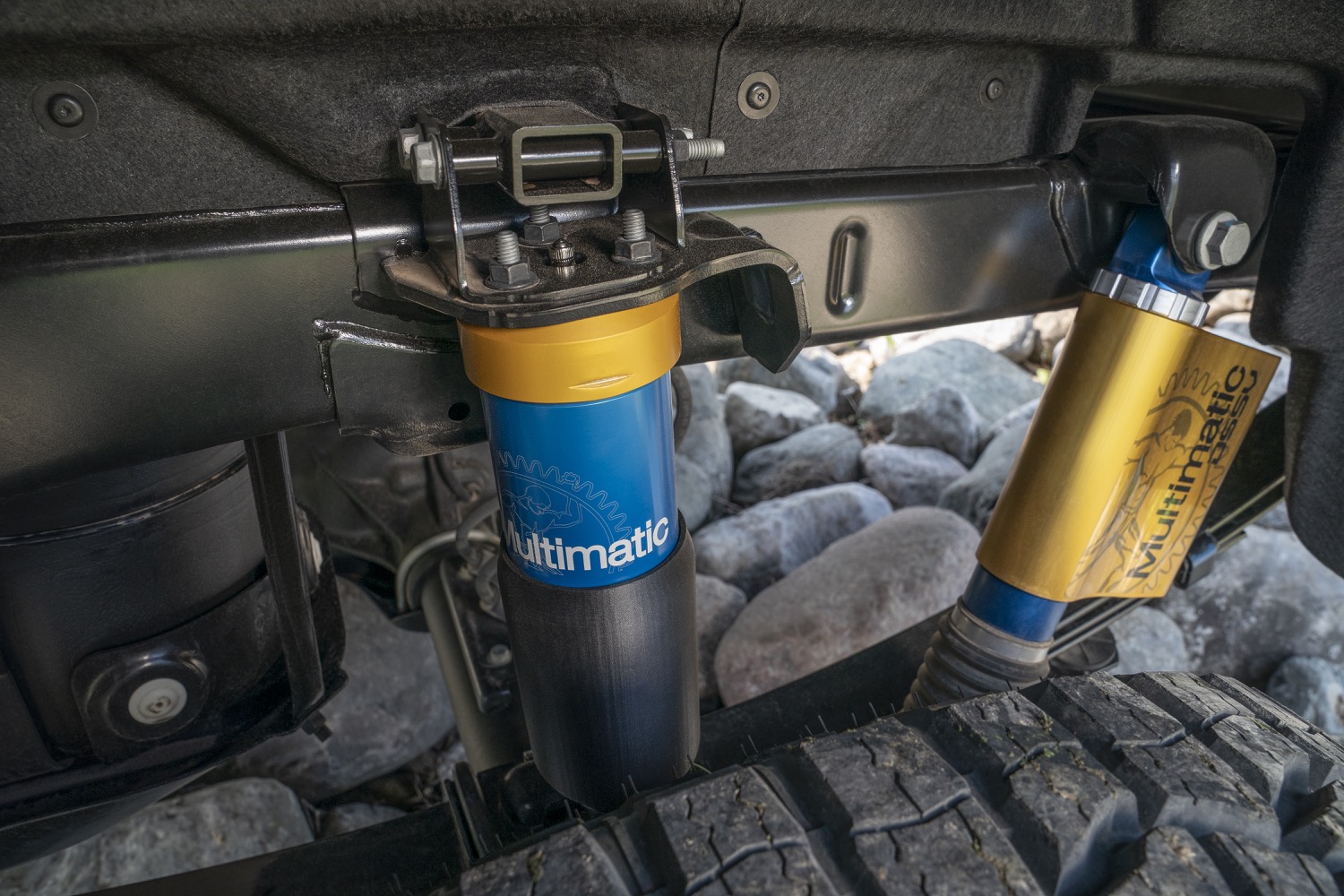

Jounce shock and DSSV damper fitted to a truck rear axle
Multimatic

Role Process engineer Dates Sep 2025 – Sep 2026 Group Multimatic Ride Dynamics

Multimatic

All experience

Production dampers

Strength through technology, through the DSSV dampers.

Damper model

A damper model I built in MATLAB and Simulink, and the tool that feeds it. The port window is drawn by hand and turned into an area curve; the model then takes one velocity input and returns the flow through that area, the force it produces, and the body and rod states. It is the piece of work here I am most pleased with, because it turns a damper from a curve you measure into a mechanism you can reason about. The scales are Multimatic's, so the plots below keep their shape and lose their values.

Where the curve starts: the port windowA tool I wrote to draw the window itself. Half the shape is drawn against a centreline and mirrored, and the area it uncovers is integrated as the spool travels, which produces the curve on the right. That curve is the input the damper model reads. Dimensions and coordinates withheld.
Top levelDamper velocity in, and the outputs the rest of the work reads: force, the body and rod positions and their derivatives, and the opening area on each side.
Inside itThe bump and rebound paths built separately from the same parts: an opening area, the pressure drop across it, and the force that follows. Block labels are left unreadable at this size on purpose.
Opening area against velocityThe geometric half of the answer: how far the spool has opened at a given velocity. Axis values withheld.
Force against velocityWhat the model produces once the flow is solved through that area. The shape is the model's answer; the scale is not mine to publish.

What I worked on

Trials, launch builds and the tooling around them. Numbers, curves and tolerances belong to Multimatic and are not here; what follows is the method and what it changed.

Program launch builds

Run-at-rate builds to prove the line could hold takt at volume, process validation against the control plan, and site acceptance testing on the new line equipment. This is the work that decides whether a damper design is actually manufacturable at rate.

Programs T1-2LD, T1-2HD Output R@R, process validation, SAT sign-off

Striker cap heat trial

Caps were breaking on the line and nobody could say why. I measured striker cap heat dissipation through a thermal soak, then tracked how often caps broke and at what temperature, which tied the failures to a thermal cause rather than to handling.

Programs 31-2, T1-1LD Tools Thermal soak rig, Excel

Honed rebound port tubes

Honing the rebound port tube was expected to help, but nobody had put a number on it. I plotted the dyno results as histograms against the population from before the change, so bump and rebound could each be judged on the spread rather than on a single sample.

Program T1-1HD Tools Python, dyno data

Piston band root cause

Found the root cause behind a cluster of rebound PSD failures: bleed hole alignment through the piston band. No fix was available inside the current design, so instead I moved the dyno software onto the second peak rather than the first, which is the one that represents what the part actually does.

Program T1-1LD Output Revised dyno measurement

Full stroke testing

Ran parts through full stroke on the dyno and compared the force-displacement behaviour against the standard PSD test, to see what the shorter test was not catching.

Program T1-2LD Output Full stroke against standard PSD

End-of-line vision testing

Worked through measurement problems on the Keyence vision systems at end of line: improved repeatability, added inspection tooling, and built reference features so the regions of inspection landed in the same place every time. Carried the remaining issues to Keyence for further improvements.

Programs T1-1HD, T1-2LD, T1-2HD Tools Keyence vision software

Operator reduction

Integrated build-operating-system ideas into the line layout and took one operator out of the line, without moving the work onto the stations either side of the gap.

Program 31-2 Output Revised line layout

Automation and tooling

Three tools, each aimed at a job people were doing by hand. A damper file search that cuts the time to find a barcode in the database, splits the results by file type and writes a log of where each one came from. A converter that rolls maximum torque across many exports into one summary workbook. And drag-select added to the dyno plotting software, so files no longer have to be added and removed one at a time.

Built in Python (VS Code), Excel VBA Covers T1-1HD, T1-2LD, T1-2HD

Programs

The damper programs I worked on, grouped by the customer they ship to. The codes are the ones they go by inside the building; T1-2LD jounce is the jounce control unit rather than a main damper.

General Motors

General Motors

Truck dampers in volume, across the light and heavy duty variants of the platform. Most of my line time, trials and launch work sat here.

ISVT1-1LDT1-1HDT1-2LD T1-2HDT1-2LD jounce31-231-XX
Silverado HD ZR2The duty cycle the heavy duty units are built for: full size, fully loaded, and off the road.
Colorado ZR2 unitsFront and rear dampers as they ship for the truck, with the jounce unit alongside.
T1XX platformThe pair that goes on the full size pickup, where wheel travel and mass are an order away from a race car.
Porsche

Porsche

Cup car dampers: the same spool valve principle as the trucks, built to a race program's tolerances and rebuild cycle rather than a production line's takt.

GT2 Cup car
Cup car on trackThe environment the damper is tuned for: one driver, one surface, and a rebuild between events.
The damper setFront and rear units with their springs, as they are delivered to the team.
Ferrari

Ferrari

A single program, the SF90, run alongside the truck work on the low volume side of the floor.

F173
SF90 XX StradaleThe car the F173 program ships on.
The F173 setFront and rear units, with the cast arm the front one mounts into.
Aston Martin

Aston Martin

Three generations of the same idea: inboard dampers on the One-77, a pushrod layout with adjustable damping and anti-dive on the Vulcan, and the adaptive spool valve on the Valiant.

One-77 · inboard DSSV Vulcan · pushrod, adjustable, anti-dive Valiant · adaptive spool valve (ASV)
One-77The car that put the dampers inboard, out of the airflow and onto the chassis.
On trackSeventy-seven built, and the layout the Vulcan and the Valiant were developed from.
Chevrolet

Chevrolet

The Camaro Z/28 was the first high volume production road car to run racing-derived spool valve dampers. The other trims of the same car kept conventional and magnetic units, which makes it a clean comparison.

2014–2015 Camaro Z/28
Camaro Z/28A road car developed to a track brief, which is why it could carry a race damper at all.
The strut, sectionedThe damper inside its spring and top mount, cut open to show how it sits in the car.
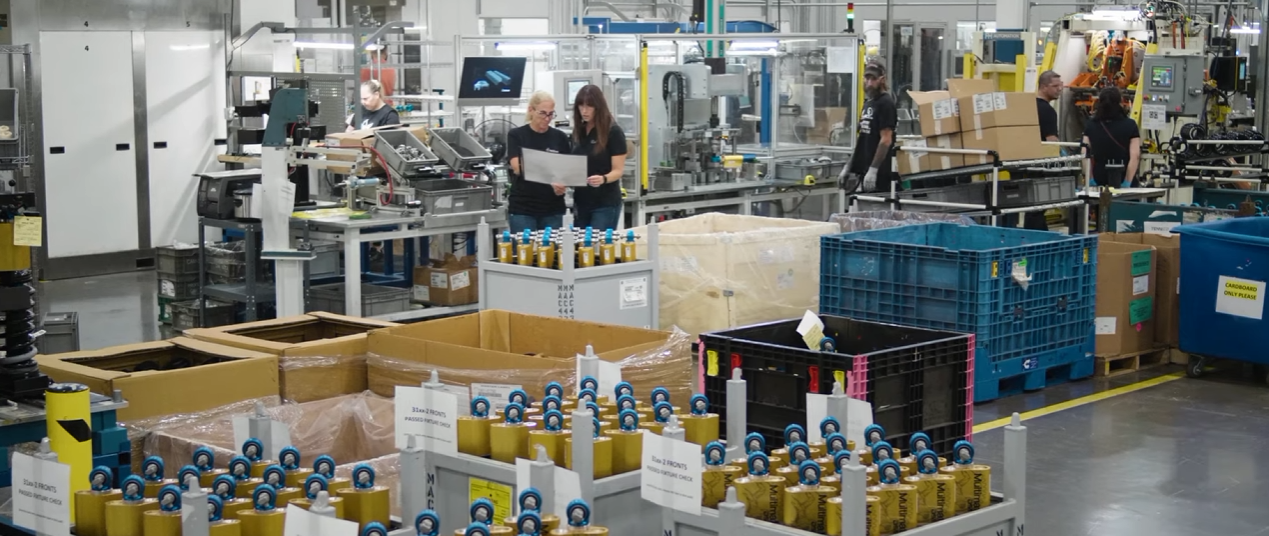
Damper assembly floor with finished units on pallets

What I took away

How a damper actually works, and the fluid mechanics underneath it: flow through an orifice, the pressure drop across it, and the force that follows. The spool's opening area is a drawing rather than a guess.

How they get built, too: manufacturing methods, end-of-line testing, and the quality system that catches a bad unit before it ships.

And sensitivity studies on real hardware rather than in a model. Honing the rebound port tubes measurably improved performance.

I enjoyed working here, and the technology is the reason.